


Factory Acceptance Testing (FAT): Why Every SP Automation Project Is Thoroughly Tested Before Delivery
Topics:
July 2026
When investing in a bespoke automation system, confidence is everything. Whether your project involves a robotic assembly cell, machine vision inspection system, special purpose machine or a fully integrated production line, you need to know that your investment will perform exactly as expected before it arrives on your factory floor.
At SP Automation & Robotics, Factory Acceptance Testing (FAT) is an essential part of every industrial automation project we deliver. Before any machine leaves our manufacturing facility, our engineers carry out a comprehensive programme of testing to ensure the system meets the agreed specification, operates safely and is ready for installation.
As a UK designer and manufacturer of bespoke automation systems, we’ve spent more than 40 years helping manufacturers improve productivity, quality and efficiency. Factory Acceptance Testing is one of the key ways we ensure every solution performs reliably from day one.
What Is Factory Acceptance Testing?
Factory Acceptance Testing, commonly known as FAT, is the final stage of testing before an automation system is delivered to the customer.
At SP Automation & Robotics, FAT is much more than a final inspection. It is a structured process that allows both our engineers and our customers to verify that every aspect of the machine has been designed, built and programmed in accordance with the original project specification.
Unlike standard production equipment, every automation system we design is bespoke. That means every Factory Acceptance Test is tailored to suit the individual application, production process and customer requirements.
The objective is simple: to prove that the complete automation solution performs safely, reliably and consistently before installation begins.
Factory Acceptance Testing Is Built Into Every SP Automation Project
Successful Factory Acceptance Testing doesn’t begin a few days before delivery, it starts at the very beginning of the project.
From the initial concept and feasibility study through to mechanical design, electrical design and PLC software development, our engineers work together to ensure the finished automation system can be fully tested before it reaches the customer’s site.
Every bespoke automation solution we design includes clearly defined acceptance criteria. This allows our engineering team to verify that all mechanical, electrical and software elements perform exactly as intended before the equipment leaves our workshop.
Because SP Automation designs complete turnkey automation solutions, FAT covers the entire system, including robotics, conveyors, machine vision, safety systems, operator interfaces and control software.
This integrated approach reduces project risk and helps ensure a smooth installation and commissioning process.
Why Factory Acceptance Testing Matters
Modern manufacturing automation systems are becoming increasingly sophisticated. A typical project may combine robotics, servo motion, machine vision, precision tooling, PLC software, safety systems and data collection into one integrated solution.
Testing each of these elements individually is important, but testing them together as one complete system is essential.
At SP Automation & Robotics, we believe it’s always better to identify and resolve any issues in our workshop than on a live production line, where downtime can quickly become expensive.
A comprehensive Factory Acceptance Test helps us to:
-
PLC Checklist to ensure all I/O is operating as intended.
- Confirm the machine performs in accordance with the agreed specification.
- Verify production speeds and cycle times.
- Ensure safety systems operate correctly.
- Validate PLC software and operator interfaces.
- Confirm machine vision systems perform reliably.
- Identify any final adjustments before delivery.
- Reduce installation and commissioning time.
- Minimise disruption to the customer’s manufacturing operation.
Ultimately, Factory Acceptance Testing provides peace of mind for everyone involved in the project.
How SP Automation Carries Out Factory Acceptance Testing
Although every project is different, our Factory Acceptance Testing process follows a structured approach developed through decades of experience designing bespoke automation systems for manufacturers across a wide range of industries.
Mechanical Inspection
Our engineers begin by carrying out a detailed mechanical inspection of the completed machine.
Every assembly is checked against the approved design to ensure it has been manufactured and installed correctly.
This includes inspecting:
- Mechanical assemblies
- Precision tooling
- Pneumatic systems
- Conveyor systems
- Robotic integration
- Machine guarding
- Cable management
- Fixtures and workholding
Any minor adjustments identified during this stage can be completed quickly within our workshop before functional testing begins.
Electrical & Control System Testing
Once the mechanical inspection has been completed, our electrical engineers verify every aspect of the control system.
This includes testing:
- Electrical control panels
- PLC hardware
- HMI interfaces
- Servo drives
- Sensors
- Actuators
- I/O devices
- Network communications
Each component is tested individually before the complete automation system is assessed as a fully integrated solution.
PLC Software & Automation Control
The software behind an automation system is just as important as the hardware itself.
At SP Automation & Robotics, our controls engineers rigorously test every PLC and HMI programme to ensure the machine behaves exactly as intended under all operating conditions.
This includes verifying:
- Automatic production sequences
- Manual operation modes
- Alarm handling
- Fault recovery
- User permissions
- Recipe management
- Production data collection
- Machine diagnostics
By testing every operating scenario, we can ensure the automation system delivers consistent, repeatable performance.
Machine Vision & Robotic Systems
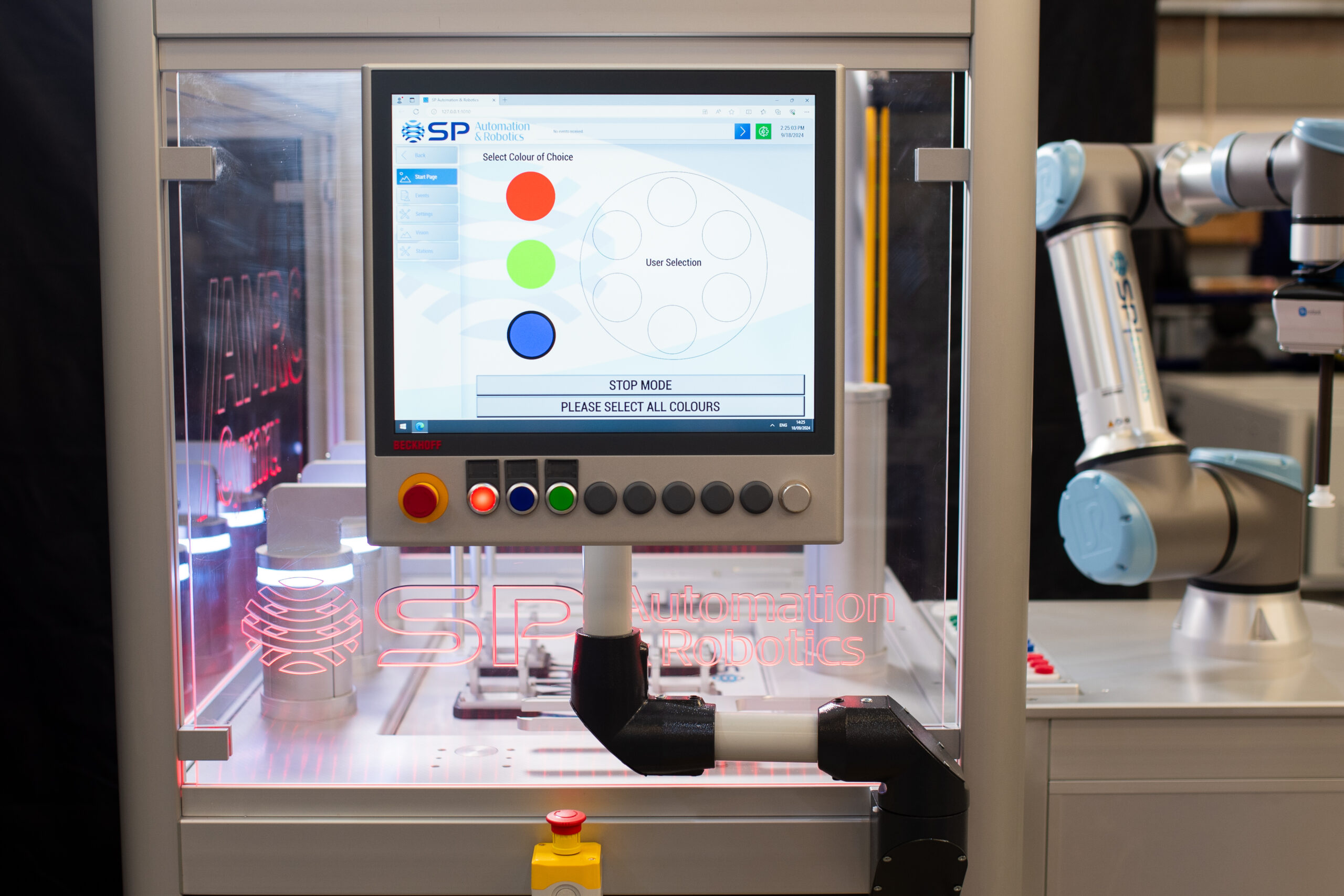
Where projects include machine vision or robotics, additional testing is carried out to verify accuracy and repeatability.
Our engineers confirm that robotic movements, vision inspection routines and automated handling systems perform consistently under realistic production conditions.
This helps ensure products are assembled, inspected or handled accurately while maintaining the required production speeds.
Safety System Validation
Safety is fundamental to every automation solution we design.
During Factory Acceptance Testing, every safety function is validated to ensure it performs correctly and complies with the agreed project requirements.
Depending on the application, this may include testing:
- Emergency stop circuits
- Guard interlocks
- Safety light curtains
- Safety scanners
- Door switches
- Robot safety functions
- Safe restart procedures
These tests help ensure operators remain protected while maintaining efficient production.
Performance Testing
The final stage of Factory Acceptance Testing focuses on overall machine performance.
Wherever possible, representative production components are used so the machine can be evaluated under conditions that closely reflect its intended application.
Performance testing typically includes:
- Cycle time verification
- Throughput
- Product quality
- Repeatability
- Accuracy
- Reject handling
- Product traceability
Only once the system consistently achieves the agreed performance criteria is it approved for customer acceptance.
Who Attends The FAT?
Early on in the project, SP Automation & Robotics agree FAT protocols with the customer. The FAT document is essential to ensure that all project stakeholders are aware of the expectations from the FAT. The document should also highlight particular tests that would be carried out to challenge the system. The document would also be used for pre-FAT testing.
At the pre-FAT stage, SP engineers would use the FAT document to conduct trials. At this stage, the customer may or may not be involved, but the results from the testing would be recorded, and any remedial work carried out.
Once an agreed FAT date is agreed, the customer would then attend, and after training, the customer would run the system as if it were in production, and record start/stops, operator intervention, and, of course, the process Pass/Fail.
Following the FAT, a report would be generated, and the results studied, to understand if the machine can be accepted. It may be that a further FAT is required.
FAT Overview
-
-
Observe full production cycles.
-
OEE performance
-
Review machine operation.
-
Carry out in-depth the testing of critical station such as test/vision etc
- Ask questions directly to our engineering team.
- Discuss any final refinements.
- Familiarise operators and maintenance personnel with the equipment
-
In summary, the FAT’s provide a rigorous testing of the machine to verify the project requirements have been achieved, and to ensure the system is fit for purpose and ready to ship for installation and on-site training.
Reducing Risk Before Installation
Installing new automation equipment into a live manufacturing environment requires careful planning.
Because much of the functional testing, software verification and system validation has already been completed during Factory Acceptance Testing, our installation and commissioning engineers can focus on integrating the equipment into the customer’s production process rather than resolving avoidable issues.
This helps to:
- Reduce project risk.
- Shorten commissioning periods.
- Minimise production downtime.
- Improve installation efficiency.
- Accelerate production start-up.
For manufacturers working to demanding production schedules, these benefits can make a significant difference.
What Happens After Factory Acceptance Testing?
Successfully completing FAT is an important milestone, but it isn’t the end of the project.
Once the equipment has been delivered, our engineers manage the installation, systems integration and Site Acceptance Testing (SAT) to verify the automation system performs correctly within the customer’s live manufacturing environment.
SAT confirms that the machine integrates successfully with existing production equipment, utilities and factory infrastructure before final handover takes place.
By managing every stage of the project, from concept design and manufacture through to installation, commissioning and after-sales support, SP Automation provides customers with a single engineering partner throughout the entire automation journey.
Why Manufacturers Choose SP Automation & Robotics
For more than four decades, SP Automation & Robotics has been helping manufacturers across the UK and internationally improve productivity through bespoke automation systems, robotics, machine vision and special purpose machinery.
Every project is built around the customer’s unique manufacturing process, and every system undergoes comprehensive Factory Acceptance Testing before delivery because we believe reliability shouldn’t be left to chance.
Our experienced team works collaboratively with customers throughout every stage of the project, combining mechanical engineering, electrical design, control systems, robotics and systems integration to deliver automation solutions that perform reliably for years to come.
Whether you’re investing in a standalone robotic cell, a vision inspection system or a fully integrated production line, you can be confident that your equipment has been thoroughly tested before it reaches your facility.
Ready to Discuss Your Next Automation Project?
If you’re planning a new industrial automation project or looking to improve an existing manufacturing process, the team at SP Automation & Robotics is here to help.
From feasibility studies and concept development through to bespoke machine design, Factory Acceptance Testing, installation and ongoing technical support, we deliver turnkey automation solutions designed around your production requirements.
Get in touch with our team today to discuss how SP Automation & Robotics can help improve your manufacturing efficiency with a bespoke automation solution that’s engineered, tested and built to perform.
Follow us on LinkedIn, Twitter & Facebook to stay updated.
Read more about our automation here…
- Benefits of Automation
- The Benefits of Machine Vision Technology
- How Much Does it Cost to Design a Special Purpose Machine
- Designing Automation Systems for Pharma
- Robots & Cobots – What is the Difference?
- Robotic Automation
- What is a URS? Why is it Important?
- Cost of Industrial Automation
Contact Us
Frequently Asked Questions
What is Factory Acceptance Testing (FAT)?
Factory Acceptance Testing (FAT) is a structured testing process carried out before an automation system is delivered to the customer. At SP Automation & Robotics, every bespoke automation system undergoes comprehensive testing to verify that it has been built to the agreed specification, operates safely and performs as expected before leaving our facility.
Why is Factory Acceptance Testing important?
Factory Acceptance Testing helps identify and resolve any issues before equipment is installed on a customer’s site. By thoroughly testing the system in our workshop, SP Automation & Robotics can reduce commissioning time, minimise disruption to production and give customers confidence that their automation solution is ready for operation.
Who attends a Factory Acceptance Test?
A Factory Acceptance Test is typically attended by members of the SP Automation & Robotics engineering team alongside representatives from the customer. This may include project managers, production managers, maintenance engineers, quality personnel or operators. Customer attendance provides an opportunity to see the machine in operation, ask questions and verify that the agreed project requirements have been met before delivery.
What is tested during Factory Acceptance Testing?
Every project is unique, but Factory Acceptance Testing typically includes:
- Mechanical inspection
- Electrical and control system testing
- PLC and HMI software verification
- Robot and machine vision testing (where applicable)
- Safety system validation
- Cycle time and performance testing
- Functional testing using representative products
These tests ensure the complete automation system operates safely, reliably and consistently before installation.
What is the difference between FAT and SAT?
Factory Acceptance Testing (FAT) takes place at SP Automation & Robotics’ facility before the equipment is delivered. It confirms that the automation system has been built and tested in accordance with the agreed specification.
Site Acceptance Testing (SAT) takes place after installation at the customer’s premises. It verifies that the system performs correctly within the live production environment and integrates successfully with existing machinery, utilities and production processes.
How long does Factory Acceptance Testing take?
The duration of Factory Acceptance Testing depends on the size and complexity of the automation project. A standalone robotic cell may require only a day of testing, while larger, fully integrated production lines or special purpose machines may take several days. At SP Automation & Robotics, we allocate sufficient time to ensure every system is thoroughly tested before delivery.
Can changes be made during Factory Acceptance Testing?
Yes. One of the key advantages of Factory Acceptance Testing is that it allows any minor adjustments or refinements to be identified before the machine is delivered. If changes are required, our engineers can usually implement and test them within our workshop, helping to avoid delays during installation and commissioning.
Is Factory Acceptance Testing a legal requirement?
Factory Acceptance Testing is not a legal requirement in itself, but it is widely recognised as industry best practice for bespoke automation systems and special purpose machinery. FAT provides documented evidence that the equipment has been tested against the agreed specification before delivery and supports a smoother installation and commissioning process.
Does every bespoke automation system require Factory Acceptance Testing?
We strongly recommend Factory Acceptance Testing for every bespoke automation project. Because every system is designed around a customer’s specific manufacturing process, FAT provides assurance that the equipment performs safely, reliably and in line with the agreed project requirements before entering production.
Why choose SP Automation & Robotics for your automation project?
With over 40 years of experience, SP Automation & Robotics designs, manufactures and installs bespoke automation systems, robotic automation solutions and special purpose machinery for manufacturers across a wide range of industries. From concept design and feasibility studies through to Factory Acceptance Testing, installation, commissioning and ongoing support, our experienced engineering team delivers turnkey automation solutions that are built around your production requirements and engineered for long-term performance.
More information
Here you can find the most important news, blogs and videos from SP Automation & Robotics.. We will highlight developments, insightful industry trends, company announcements, technology expos, conferences, and events.